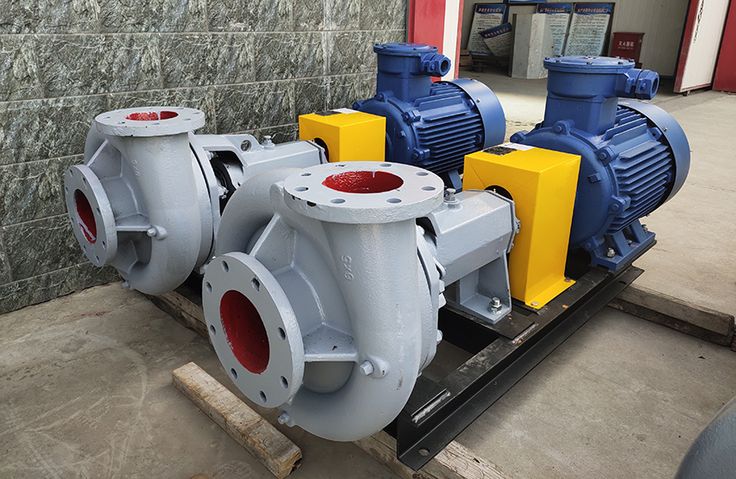
Fluoroplastic self-priming pumps, also known as the TIZF series fluoroplastic self-priming pumps, are designed and manufactured in accordance with international standards and the manufacturing processes for non-metallic pumps. The pump structure adopts a self-priming design. The pump casing consists of a metal shell lined with fluoroplastic, and all wetted parts are made of fluoroplastic alloy. Components like the pump cover and impeller are manufactured by integrally sintering and pressing metal inserts coated with fluoroplastic. The shaft seal utilizes an advanced external bellows mechanical seal. The stationary ring is made of 99.9% alumina ceramic (or silicon nitride), and the rotating ring is made of PTFE-filled material, ensuring highly stable corrosion resistance, wear resistance, and sealing performance.
A fluoroplastic self-priming pump does not require priming before startup (although the initial installation still requires priming). After a short period of operation, the pump can draw fluid up and commence normal operation through its own action.
Fluoroplastic self-priming pumps can be classified by their operating principle into the following categories:
1.Gas-liquid mixing type (including internal mixing and external mixing).
2.Water ring type.
3.Jet type (including liquid jet and gas jet).
Working process of the gas-liquid mixing self-priming pump: Due to the special structure of the pump casing, a certain amount of water remains in the pump after it stops. When the pump is started again, the rotation of the impeller fully mixes the air in the suction line with the water. This mixture is discharged into the gas-water separation chamber. The gas in the upper part of the separation chamber escapes, while the water in the lower part returns to the impeller to mix again with the remaining air in the suction line. This process continues until all gas in the pump and suction line is expelled, completing the self-priming process and allowing normal pumping.
Water ring self-priming pumps integrate a water ring and the pump impeller within a single housing, using the water ring to expel gas and achieve self-priming. Once the pump operates normally, the passage between the water ring and the impeller can be closed off via a valve, and the liquid within the water ring can be drained.
Jet self-priming pumps: consist of a centrifugal pump combined with a jet pump (or ejector). They rely on the ejector device to create a vacuum at the nozzle to achieve suction.
The self-priming height of a fluoroplastic self-priming pump is related to factors such as the front impeller seal clearance, pump speed, and liquid level height in the separation chamber. A smaller front impeller seal clearance results in a greater self-priming height, typically set between 0.3-0.5 mm. If the clearance increases, besides a decrease in self-priming height, the pump's head and efficiency also reduce. The self-priming height increases with the rise in the impeller's peripheral velocity (u2). However, once the maximum self-priming height is reached, further speed increases will not raise the height but only shorten the priming time. If the speed decreases, the self-priming height also decreases. Under other constant conditions, the self-priming height increases with a higher stored water level (but should not exceed the optimal water level for the separation chamber).
To better facilitate gas-liquid mixing within the self-priming pump, the impeller should have fewer blades, increasing the pitch of the blade grid. It is also advisable to use a semi-open impeller (or an impeller with wider flow channels), as this allows the returning water to penetrate more deeply into the impeller blade grid.
Most fluoroplastic self-priming pumps are matched with internal combustion engines and mounted on movable carts, making them suitable for field operations.
What is the working principle of a fluoroplastic self-priming pump?
For a standard centrifugal pump, if the suction liquid level is below the impeller, it must be primed with water before startup, which is inconvenient. To retain water in the pump, a foot valve is required at the inlet of the suction pipe, but this valve causes significant hydraulic losses during operation.
A self-priming pump, as described above, does not require priming before startup (except for the initial installation). After a short operation, it can draw fluid up and begin normal operation. The classification and working principles of the different self-priming types (gas-liquid mixing, water ring, jet) are as previously detailed.